A Jeremiad on Modern Education
My Winning Ready Writing Essay for this year’s district contest. Please email me your thoughts!
Erasmus wrote that society was only as fit as the education system upon which it sat. Twain seemed to think that we weren’t doing a great job: “I never let my schooling interfere with my education,” he quipped. Churchill was with him: “The best argument against democracy is a five minute conversation with the average voter.” And Petrarch, an early Renaissance philosopher considered as the founder of humanism, would have agreed with both. In his “Letter to Livy,” he lamented that he was tired of men who, only motivated by the prospects of gold and silver, had taken over society to pursue their own wealth, and, in the process, corrupted that which was God’s greatest gift to man; that is, the immense potential for knowledge and learning and virtue made possible by curiosity. Alarmingly, there is something strikingly similar between Petrarch’s astute diagnoses of his society and observations the average American high schooler can make about the modern age. Education in particular has suffered; no longer is it a way to achieve enlightenment. Now it seems to be no more than an annoying means to an end, that being a high salary. Interestingly, there is no question that Petrarch’s time was one of savagery. It was the late 14th century, and Europe was just beginning to crawl out from under the dark cloak of feudalism. Education was inaccessible to the masses, and most people could not read. This was by design. The clergy, seeking to enrich itself (especially under the tenure of Pope Julius, who sought funds to build St. Peter’s Basilica in Rome), refused to give sermons in the vernacular, instead opting to orate in Latin so that the masses could not understand. Imagine being a German listening to a man down the aisle yapping away in some foreign gibberish! The zeitgeist of the Dark Ages was, as Hegel put it, not one of skepticism and curiosity, but one of acceptance and conformity. People could not read or write or think independently, and so they suffered. Something similar is occurring in modern America, albeit a modern variant where royal courts of gossip have been replaced with Reddit forums, cathedrals with data centers, and violent politics with unprecedented partisanship in D.C. Many of these issues can be traced back to the modern school system, which has failed to prioritize the one thing that produces meaning for young people and, by extension, has caused the decline of a cohesive, civil, enlightened society: the chance to be curious; to explore; to have liberty in the pursuit of knowledge; the chance to be skeptical and ask questions that lead to more questions and so on and so forth. Instead, much of our youth has ceased to ask those difficult questions—but the blame cannot be squarely put upon them. When reading books is no longer a requirement, when literacy rates plummet, when distractions are seductively present, when the goal of a class is to pass a standardized exam that tests memorization and not creativity, when a fast car is prized over a fast mind—this is when curiosity dies and society fails.
Consider the two dystopian classics 1984 and Fahrenheit 451 (which are no longer required readings in school). Though 1984 is primarily about the surveillance of a totalitarian state, Orwell shows the reader through piercing prose the mental and physical torture that arises when one is clueless about himself. Indeed, Winston cannot even remember his own life; he cannot recall his parents, he only retains small fragments of memories that he struggles to piece together, he falls victim to his impulses in pursuing Julia, and, by the end of the novel, he completely accepts Big Brother as his master. Similarly, Bradbury uses Clarisse to represent what education has to offer: another perspective, answer, or possibility. Another way of living life—a better way, even. Was it ever a pleasure to burn? A pleasure to rewrite history? To hurl the old newspapers into the Ministry of Truth’s great incinerators so that they may never be seen again? Of course not. Guy found no true meaning when he hosed down the house with the Salamander at the beginning of the novel, nor did he feel joy when he burned the books and the woman toward the middle. And neither did Winston as he worked in the white pyramid of “truth.” The difference between the two novels is that Winston succumbed to O’Brien and Big Brother while Montag managed to escape the comfortable claws of ignorance and conformity. In their own different ways, both authors argue that true education—curiosity, skepticism, questioning, discussing—is what lifts an individual out of dystopia and into the light.
The benefits to an education based on curiosity and service, rather than the current one based on AP classes and competitive admissions, is also more practical for the modern economy and the well being of the student long-term. In his Atlantic feature article “How the Ivy League Broke America,” cultural commentator David Brooks states that classrooms that pivot away from the traditional classroom experience and instead focus on projects and individual learning, like the Alpha school in Austin, actually produced higher SAT scores and better extracurricular activities than did public schools that stuck to the traditional pathway of constant testing and homework assignments. While the hefty $40,000/year tuition is completely unfeasible for the vast majority of American students, the result it has had on graduates, and what they go on to do in the world, like writing influential articles in the New York Times and starting humanitarian nonprofits that help thousands worldwide, should not go unnoticed.
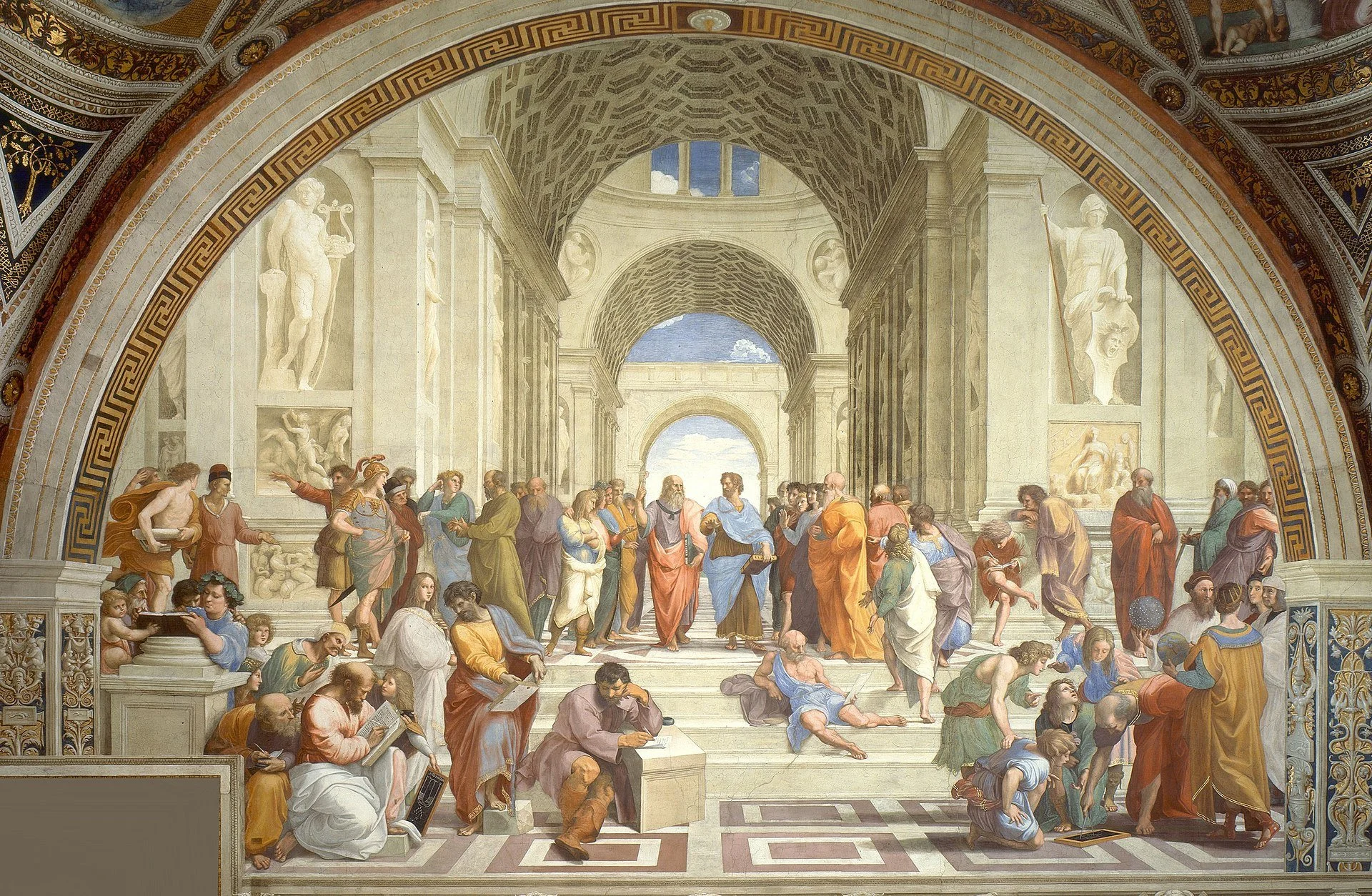
While we do not live in an age of progress, like Spinoza and DaVinci did, or in the age of skepticism, like Newton and Leibniz did, there is a way out: a return to humanism and rationality and curiosity. Or, in other words, a return to a philosophy based on the human, not on the economy or on the arbitrary measures of success set by society. The good news is that schools can choose quite easily whether they want their students to be part of the Great Conversation—that is, the ongoing dialogue between the philosophers throughout the ages over the Big Questions: what is love? What is beauty? What’s good and what’s evil? Does God exist? By asking these questions, we can steer our students back to the intrinsic topics that give life meaning and help them explore their own identities and their place in the world.
Many philosophers, especially those of the 20th century, realized that there is a kind of inherent absurdity that characterizes our universe—one that transcends the laws of thermodynamics and entropy. One of the most significant of those contradictions that define the human experience, as Sartre argues in his seminal lecture Existentialism is a Humanism, is free will. Man, he laments, is not bestowed the gift of free will; no—indeed, he is doomed to be free. There is paradoxically an upside to this: we may suffer for it, yet we are in full control of our destiny. In other words, we can mold ourselves into whatever form we wish to embody. Perhaps if schools were to act as a North Star, as a guiding force prodding the youth’s will and outlook on life toward humanism—not necessarily just toward a 1600 SAT, or a 5 on an AP test, or an acceptance to Stanford—only then could we young students now entering the real world for the first time find our way through curiosity and questioning, change the world, and proudly prove Twain, Churchill, and Petrarch wrong with a prosperous, enlightened, happy future.