
The Death of Humanism
The Decline of American Culture and the Rise of the Mass Man
My high school is a microcosm of society. There are the out-of-touch administrators who, much like our lawmakers, seem to care exclusively about securing funding rather than the mental health of their students. There are the outcasts, who eat lunch alone in the corners of the cafeteria but are some of the nicest people I’ve encountered. There are the teachers, some of whom are uncompromising sadists, others who are saints (God bless their souls). There are the hedonists, who are popular in a superficial sense but lack deeper engagement with life. There are the future finance bros who, on their college applications, promised to dedicate their lives to “empowering underserved communities.” (By working at Goldman Sachs.) Then there are the social activists who, intent on saving the world, post Instagram stories to promote their thoroughly researched political opinions. (Which they pulled off of 30-second Tik Tok analyses.) Finally, there are the preprofessionals, whose lives revolve around working for a white-shoe firm or attending an elite institution of highest possible prestige. (I mean of higher learning, of course.)
But public high school is more than just a representative sample of society; it serves as a crystal ball in that it offers the inquirer a taste of the world, what he will encounter there, and his place within the brutality—and beauty—of it all. Will he be a lawmaker, a banker, a doctor, a scientist? A philosopher, novelist, or journalist? Will he be a people person or a loner? A sycophant or a nonconformist? I’ve been stuck in this strange simulation for far too long, but because of that I’ve gleaned some insights on the nature of my generation and of our society more broadly that have shaped my worldview and will probably stick with me for the rest of my life. One such idea, the one (of many) I’d like to talk about today, is that public schools are emblematic of our problematic zeitgeist, or our “spirit of the times.”
Zeitgeists have come in many forms over the millennia. The Age of Enlightenment, for instance, was a time of reason, individualism, and skepticism of the dominant religious, ideological, and political dogmas propagated by traditional institutions. This zeitgeist inspired the founding of America on the basis of basic freedoms, or “natural rights.” The Romantic Era, from the late-18th century to the mid-19th century, was a time of rebellion—rebellion against the Industrial Revolution’s mechanization, against its exploitation of nature, against its subversion of emotion, and even a pushback from the strict rationalism of the preceding Age of Enlightenment. The Romantics include some of the greatest literary philosophers of the Western canon in Emerson and Thoreau. The Scientific Revolution was another age of reason; it offered us calculus and Newtonian physics and the scientific method. Some zeitgeists, some cultures, some ideologies, especially those in Western Europe over the past few centuries, have significantly advanced humanity both technologically and humanistically.
Other zeitgeists have not. The obvious Western example is Medieval Europe. Sure, there were some technological and social improvements during this time—the heavy plough, the compass, the university, Gothic architecture. But for a 300,000-year-old race capable of critical thinking it was a thousand years that released a flood tide of immense, pointless suffering and utter savagery. Life was, as Hobbes put it, “nasty, brutish, and short.” Petrarch, a writer who many consider to be the father of humanism, eloquently describes the prevailing attitudes of the times in a 14th century letter addressed to the Roman historian Livy: “Often I am filled with bitter indignation against the morals of today,” he laments, “when men value nothing except gold and silver, and desire nothing except sensual, physical pleasures.” His insight offers us a perspective on why the Dark Ages were considered “dark”: not much is known about it besides war and feudalism. Nobles were busy waging wars, knights were busy killing each other in those wars, and the peasants were busy subsistence farming on their nobles’ manors. The elites and clergy, rather than trying to uplift and propel the human race, seemed motivated purely by the selfish pursuit of wealth and status, and extracted as much wealth as they could from their peasants to fund their absurdly extravagant lifestyles. In retrospect it looks more like barbarity than civilization, especially for a system that claimed to value chivalry and honor above all else. Indeed, the life of the average Medieval peasant seems to the ambitious capitalist to be a bizarre, wasted one. Nevertheless, it feels like the West has chosen (or been subconsciously coerced) to crawl back to the Dark Ages, albeit a modern strain where cathedrals are replaced with Facebook, town squares with Instagram, and feudalism with some sort of technofeudalism.
Ideological shifts are often reactionary. The Renaissance was a reaction to the preceding age, the Middle Ages, as was the Enlightenment to Absolutism, Romanticism to the Enlightenment, and Modernism to Romanticism. With this in mind, the astute observer can look at our society and ascertain our zeitgeist: one dominated by cynicism—the belief that people are grossly selfish and that the only way to succeed is through ruthless self-interest. Coming from the Ancient Greek word kynikos, meaning “dog-like,” referring to the uncouth lifestyle of the cynic philosophers who lived off scraps and slept on the streets, cynicism characterizes much of the current American political, moral, and economic landscape. Symbolically, our president has just hosted a UFC fight on the White House lawn for his birthday—quite “dog-like” indeed, this writer thinks—while the opposition twerks for votes and changes their accents depending on the crowd—more snake-like than dog-like. The need for conservatives to portray themselves as tough and rough, yelling at the American public that the only way forward is through jingoism and violence, is just as depressing as the liberals’ strange desire to liberate us from liberalism through insecure borders and soft-on-crime sanctuary cities.
Our time is one formed in the middle of one of these ideological shifts, a time defined by a grinding between disparate philosophies. The neoconservatism of the late 1990s and early 2000s, with its confidence in institutions, global order, and top-down authority, collided with the deeply skeptical, decentralized, and disillusioned culture in the late 2010s, leaving a generation that felt undone by perceived widening social inequality and a K-shaped economy. Then came the (literally) explosive Great Awokening of the 2020s, a massive cultural overshoot characterized by critical race theory, violent riots, and chaos. Naturally, the left-wing’s ideological revolution produced its own antithesis, an equal and opposite repulsive reaction: the far-right manosphere and incel culture. Two new groups emerged in the aftermath of this bang. On the political right formed a generation of young men shaped by 30-second clips on social media of anti-establishment ideas: figures like Andrew Tate and Nick Fuentes promoting pervasive distrust of grand, unifying truths, and edits warning against the Davos man* and the Jew. On the left was a rise in the collectivist ethos, in democratic socialism, and extraordinarily, communism. Traditional institutions—the media, the university, the government—have been largely discredited by a chaotic plurality where information is abundant and truth, the full truth delivered with context, is scarce. Simultaneously, there is a cultural identity crisis, a tension between individualism and collectivism, logic and feeling. People look with increasing admiration at populist politicians like Bernie Sanders and Zohran Mamdani, charismatic speakers who promise action against “them,” the 1%, to improve the lives of “the people.” Trump himself won off a similar type of “us versus them” populism, though his took its roots in polar opposite values.
All of this, whatever this is, leaves us with a new zeitgeist—the spirit of the 2020s in all of its novelty, an equally absurd reaction to the craziness of the great Awokening. And it truly is a time of newness: Trump’s second presidency, the explosive growth of LLMs, the decline of the American moral compass. There is much to think about that manifests itself in the popular opinion of high schoolers, and metabolizing those insights has left me with one conclusion: Our zeitgeist is not centered around a humanistic philosophy that uplifts man but a materialistic one that atrophies and destroys him. We’ve built bigger, better computers; stocks are higher than ever; AI will supposedly eliminate the need to work. These advancements seem positive in the short run. But somewhere along the way, many of us lost parts of our humanity that are much more valuable in the long run: our attention spans, our ability to think critically, our curiosity, our creativity, our morals, our ambition, our romanticism. What good is the newest rocket if we use it as a bomb rather than as a vessel to explore the cosmos? What good is freedom if we don’t know how to use that freedom, or if others too strongly influence how we should use that freedom? What good is money if we have no greater purpose other than making more money?
As such, the problems of our generation are, as usual, external, but perhaps unique in that they are also profoundly internal. While we used to suffer under constant existential threats of disease and invasion our new problems are fundamentally different. Porn, Instagram, and deeply flawed institutions are issues that, at first glance, seem much tamer than some of the ostensibly insurmountable challenges humanity has faced—plagues, world wars, cold wars, depressions—in the past. Tik Tok can’t directly smite people down like a virus or a bullet can. But upon closer look, these trends manifest themselves just as deadly. They can be capsulized in one word: degeneracy.
In 1984 Orwell posits that a totalitarian government will control society through surveillance and terror. Huxley’s converse, Brave New World, on the other hand, argues that an external threat won’t even need to use force to implement its distorted goal of world domination; the masses, incapable of ditching the comforts of constant dopamine and distraction and pleasure, will commit suicide and take care of their demise themselves. This series of essays argues that though Orwell may have been partially correct in his diagnoses of future societies, the essence of Huxley’s prediction, a much more depressing one than Orwell’s, has been realized almost in its entirety.
After observing the world closely through high school, both through direct experience and through literature, the many “why” questions that have bugged me for years are these. Why do young people, myself included, seem dumber? Why has schooling become a job rather than a joy? Why do people hate each other? Why has learning for the sake of learning largely disappeared? Why do so many smart people want to become investment bankers and consultants? Why has curiosity disappeared? Why are those who purportedly care about society so extreme? Why do many people not care about the trajectory of our society at all? Why are so many people depressed? Why is the world getting uglier? These questions can be combined into one broad question: Why does it seem like our society is in rampant decline?
As with most questions like these, there are no simple answers; cultures are neither built in a day nor do they fall in a day. The declines of empires and cultures typically happen because of various failures on multiple fronts simultaneously. To be clear, at the core of great progress are individuals, not institutions. It was Newton who developed modern physics, not his ruler King Charles; similarly, it was Galileo who promoted science and truth, certainly not the Church under which he was subjugated. That said, while individuals induce progress, institutions have the ability to produce and cultivate those individuals on a mass scale. The Renaissance, for example, produced a disproportionate amount of geniuses in part because it coincided with the advent of the printing press (and hence more people could read and pursue education) but also because the Medicis of Florence, though brutal in their own regard, promoted a culture of excellence around the humanist pursuits of art and literature. Similarly, the Scientific Revolution and Age of Enlightenment that characterized much of Newton’s time contributed to the spread of his ideas and the advent of corollaries within a relatively short period.
So, to answer these questions, we should largely look at the systems, not at the certain individuals, that influence our culture and therefore produce the kind of individuals that compose our society. With that reasoning established, there are four systemic problems that come to my mind quickly—issues that I can easily identify and speak to based on experience. Problems that if addressed seriously, honestly, and aggressively, may greatly improve the lives of American children and, by extension, the future of our society, which will eventually depend on this generation. The essay is divided into five sections. The symptoms: 1) a loss of shared values and 2) the abolition of beauty; the causes: 3) the rise of the “mass man” and 4) the pathetic public school system; and the solution: 5) humanism. I’ll describe the problems in Part I and address them to the best of my ability in Part II. To be clear: this essay is not meant to express some irrational reverence for “the past” broadly conceived—just the narrow aspects we can reasonably respect. Nor is it a neo-Luddite lamentation calling for a return to some prior age; it is simply an attempt to describe my high school experience and, when possible, learn from history what not to do in the future.
I should also note that it’s always easier to point out problems than to solve them, and though I seem pessimistic in this introduction I do truly have hope for Western civilization. If we pair our technological prowess with a deeply humanistic core, the West has the potential to be a beacon of freedom, self-reliance, and prosperity for generations to come—the country our founding fathers envisioned it to be: a nation of hardworking, good people with a steadfast dedication to life, liberty, and happiness for all. The end of the essay will reflect this attitude and explore alternatives to our vapid status quo.
1. A Loss of Shared Values
At the core of any society is a set of shared values and traditions, legends and heroes. Ancient Rome, for instance, revolved around the mos maiorum, or the “way of the elders,” a consortium of unwritten social norms that stressed pietas (duty), gravitas (seriousness),and disciplina (discipline). In Sparta all aspects of life were focused on the military. Athens emphasized knowledge and learning and wisdom. The Han Dynasty in China adopted Confucianism as its official state philosophy. Soviet leadership imposed Marxist-Leninism, atheism, and patriotism onto their population. Or consider the Nazis, who militarized Germany and created a cult of personality around Hitler—“the Fuehrer and the law are one,” as Goering put it. These principles may not have been appreciated by the populace in its entirety, but they were what held the societies together.
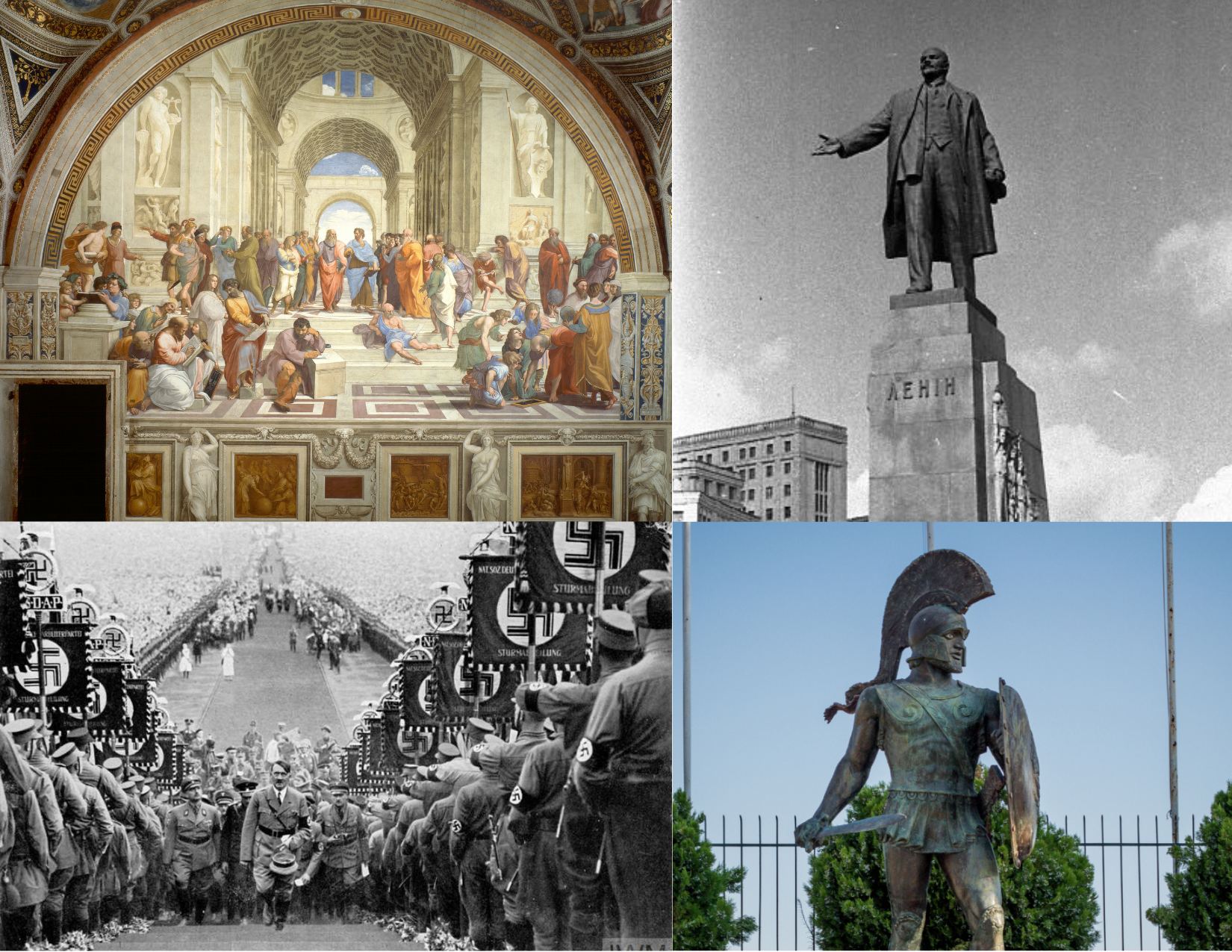
From top left clockwise: Raphael’s School of Athens; Statue of Lenin in Kharkiv; Monument to Leonidas, King of Sparta; and Adolf Hitler at a rally in Nuremberg. Note: A mere 6 years after Gorbachev introduced glasnost the mighty Soviet Union collapsed.
But purpose is also important on the individual level. When people have nothing left to be proud of they begin to search for identity elsewhere: ethnicity, religion, skin color, gender, IQ, political party, nationality—things that, because they have nothing to do with individual merit, Schopenhauer believed induced “the cheapest sort of pride.” History teaches us that it’s also the most dangerous kind of pride, one that inevitably results in scapegoating, extremism, and in many cases bloodshed. Because most rational people prefer classical Western values—liberalism over authoritarianism, humanity over brutality, etc.—over fanatic ones, as seen in Sharia Law or in the Nuremberg Laws, it is vital that we dictate what our values are before someone with more sinister intentions sways the frustrated mob as Khomeini did in 1987 and Hitler in the 1930s.
America is, I think, less vulnerable to such demagoguery. But this doesn’t mean that she hasn’t struggled with her self image. Ever since the beginning there has been tension implicit in America’s founding idea: unlike the people of typical nation-states—England is composed of the English, France of the French, Germany of the Germans—Americans do not all share a common ancestry. The American populace is, as Jill Lepore writes in These Truths, “descended from slaves and slave owners, from conquerors and the conquered, from immigrants and from people who have fought to end immigration.” Woven throughout the American social fabric, holding it all together, is not shared blood and flesh, but shared words and ideas valued by all: the freedom to speak one’s mind, to practice one’s chosen religion, to petition against the government.
Unfortunately, large chunks of the American youth are lost, because there is no broad set of values we can all agree on; and they are therefore susceptible to such demagoguery and sophistry. Besides the World Cup happening now, there is no nationwide project to take pride in. There is no tangible, existential, global, good-versus-evil war like World War II to unite behind. The conflicts in the Middle East, Ukraine, and Sudan are foreign, halfway across the world. The capitalism that defined much of early American success and enabled the coveted American dream died and was replaced with crony crapitalism, the welfare state, and unsustainable tax cuts on the elite. The entire point of the American experiment was for an enlightened populace to unite not around hatred for a common enemy but around love for a common idea of righteousness and truth and virtue. But now more so than ever it seems like many people are either passionately ignorant or ignorantly dispassionate.
There are also few scientific advancements to be excited about. We certainly aren’t sending a man to a different planet or exploring the universe. Instead, the new generation inheriting Silicon Valley spends time and money working toward AI girlfriends, gambling sites, and ChatGPT-wrapper study tool apps. This is not to mention that outside of the world of bits and bytes, the physical world is remarkably underdeveloped in comparison. As Peter Thiel quipped in 2011, “We wanted flying cars, instead we got 140 characters.” Solar is still inefficient, Tesla is the only semi-futuristic affordable car, Alzheimer’s and ALS still have no cure. There’s much to be excited about—reusable rockets, gene editing, self-driving—but one feels there could be more.
In fact the nation seems to be going the other way. Many are taking stands and uniting around issues they may find important but don't fully understand. Almost every conversation I have with certain individuals, for example, surrounds Jews. Blaming Israel, and the Jews more broadly, for all of our problems at home is easy and fashionable. It gives one a sense of community, especially online, where users can feel the adrenaline of an angry 15th-century mob with pitchforks (or dildos in the modern age), and an excuse for one’s own shortcomings. Art is also, as we will discuss soon, on the downturn.
Regrettably, history rhymes, and these trends shouldn’t be surprising. Young adults no longer have faith in the bigger, better ideas—the “meritocracy,” the “greater good,” the “American dream.” The ideas that used to define American greatness now feel to many like anachronisms. The easy explanation, then, is that it must be someone else’s fault: the government, the system, the cabal. As Rome lost its traditional values, Sparta its military, Athens its wisdom, and Han China its Confucian ideals, each respective society fractured and met its demise, sometimes quickly, sometimes slowly. We should expect that as America loses her values—liberalism, critical thought, rationality—she will, like any other society, follow that general pattern of passing.
The big questions are therefore: What are the values of the average young American? And what’s causing us to embrace those values? Where are we headed? There are a couple of places to look: at our politics, our celebrities, our music, our buildings, and our everyday habits. In other words, at our deeply fragmented culture.
2. The Abolition of Beauty
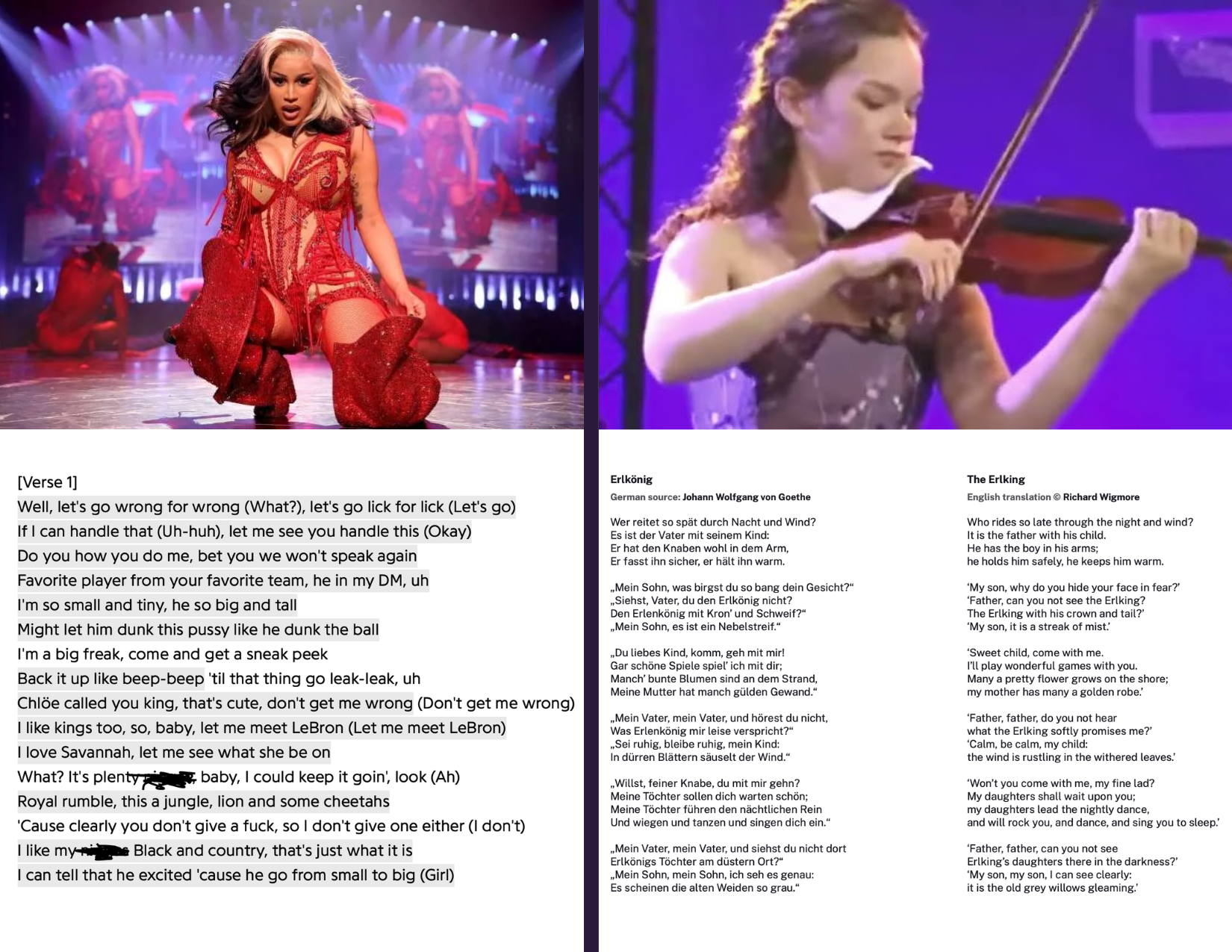
Left: Cardi B at a concert. Below are the lyrics to her recent song, presumably about her ex-husband known as Offset. Right: Hilary Hahn performing Schubert’s Erlkönig on violin, a song written to Goethe’s poem by the same name about a mystical, sinister king taking the life of a young boy as his father races home in vain.
In The Idiot, Dostoevsky prophesizes that beauty will save the world. I’m inclined to agree with the old Russian. The present world is unkind to beauty, especially to complex beauty. Those who enjoy classical music—which tells grand stories, evokes complex emotions, and requires attention for longer than 3 minutes—warrant looks of disgust from peers when asked what music they listen to; rap and pop music with tangy beats and grotesque, superficial lyrics (some artists, like Biggie, who can tell a story with his music, are objectively better than others, like Cardi B, who only ever seems to think about sex) are now the obvious choices if one wishes to be a man or woman of the times. The visual arts have undergone a similar transition. A glance at the winning pieces of the YoungArts competition—which boasts a 6% acceptance rate—yields much disappointment. Surely this is not the best our country has to offer! That novelty can be fascinating is true, but it is not inherently virtuous—a strange notion that mass media, in its effort to capture our attention, has used to disfigure our brains.
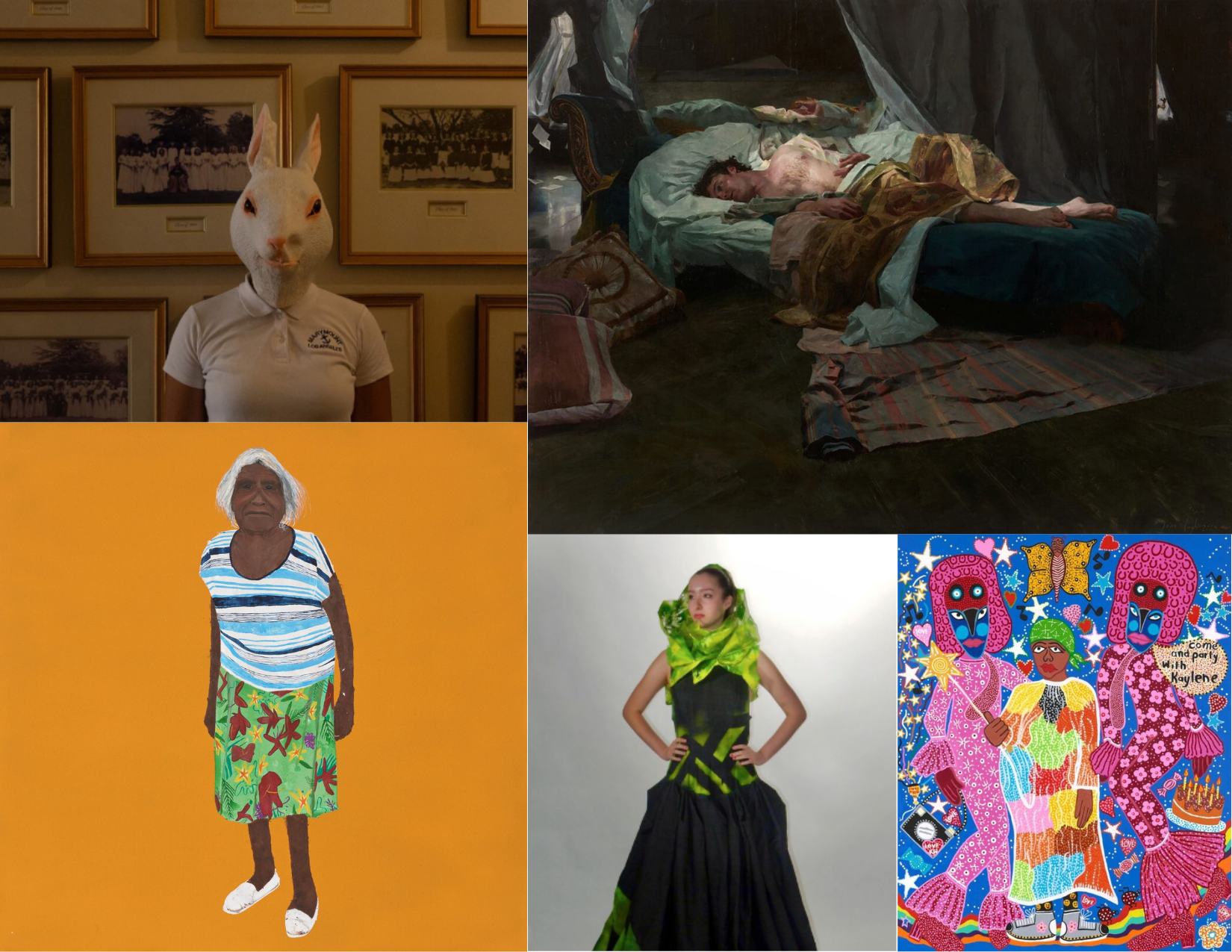
Top left: A winner of YoungArts photography. Bottom left: Winner of the Archibald prize, Australia’s most prestigious art competition. Bottom right: A Winner of YoungArts design, and finalist for the Archibald prize. Top right: Runner-up to the Archibald prize, meaning it lost to Bottom Left and was barely better than bottom right.
But Dostoevsky’s claim—that beauty will save the world—is vague. What is beauty? How can something so abstract result in something so tangible as saving the world? And what is beauty saving the world from?
The answer to the third question seems self-evident: the Beautiful is “good” and saves the world from the “bad,” from the Ugly. But this view does not withstand scrutiny. Because beautiful art—strokes on a canvas, phrases from a speech, notes from a score—can represent both conventionally “good” and “bad” ideas, beauty serves incompatible moral ends and can inspire both vice and virtue. But, though beauty qua beauty is neutral, it may be said that beauty is one of the most effective methods of communicating an idea. Take, for example, Hitler’s relationship with composer Richard Wagner. As a tramp living in and out of Viennese hostels and gutters, young Hitler, when not reading German mythology or fantasizing about blondies, would lurk in the back of the Wiener Hofoper (the Vienna State Operahouse) and listen in awe to Wagner’s grand operas Die Meistersinger and Tristan und Isolde. It is difficult for one to deny that Wagner’s music is striking and indeed beautiful in a quintessentially German Romantic way, notwithstanding the gruesome stories and messages that Hitler appropriated from Wagner and injected into the German mind through a similarly aesthetic and mythic vision.
I believe Dostoesvsky meant that beauty would save the world from graver sins: indifference and ignorance. He foresaw the importance of beauty as the only way to grip the human soul, to teach it and to mold it into a better shape. Shirer’s Rise and Fall of the Third Reich for instance is, to me, beautiful—not because of its subject matter, of course, but because of the writer’s storytelling, reminiscent of Homer and Herodotus; of his command of the English language; of how he uses phrases and words to sway his reader and teach him new things, fascinating things, terrible things, in a thoroughly engaging way. In this way a beautiful thing—the book—describes a terrible thing—the rise and fall of Nazi Germany—and by engaging others, by compelling them not to repeat the same mistakes, saves the world one reader at a time. Textbooks in all their erudite dryness fail to have the same effect as Shirer’s magnum opus; they educate, but they don’t transform. Just as textbooks create educated but dispassionate students, dry teachers effect no change in their students. In short, information may educate, but beauty—beautiful oration, beautiful landscapes, beautiful architecture—in the service of virtuous intent, transforms worldviews and leads to real change.
Problems arise when we are both ignorant and indifferent, and this writer believes that ignorance and indifference are due in part to a lack of beauty in modernity. Worse, we have become so distracted—by our phones, our emails, our next internships—that we aren’t even curious as to why these trends are ruining our lives. For one, we no longer ask what beauty is, and the ramifications of such indifference have ruined many aspects of our cities. Consider how this has manifested in architecture and design. The obvious question we should ask ourselves when scrutinizing design is why? Why is this building shaped in this way and not that? What is the architect trying to convey with marble over concrete, or with an arch over a beam? These questions are worth asking, because architecture is the tangible expression of a society’s, a business’s, or an individual’s values. We are all the time exposed to design. We look at architecture on the way to school or work; on the way home; on the way to the supermarket; we notice the design of the office, of the school, of the supermarket. Whole Foods buildings, for instance, often feature steel beams and modern industrial light fixtures with light brown wooden accents for a warm, organic feel. The Empire State building with its Art Deco flourish conjures thoughts of capitalism and wealth and the American dream. Dubai’s sleek futurism evokes soulless materialism, and Vienna’s Baroque style elicits culture.
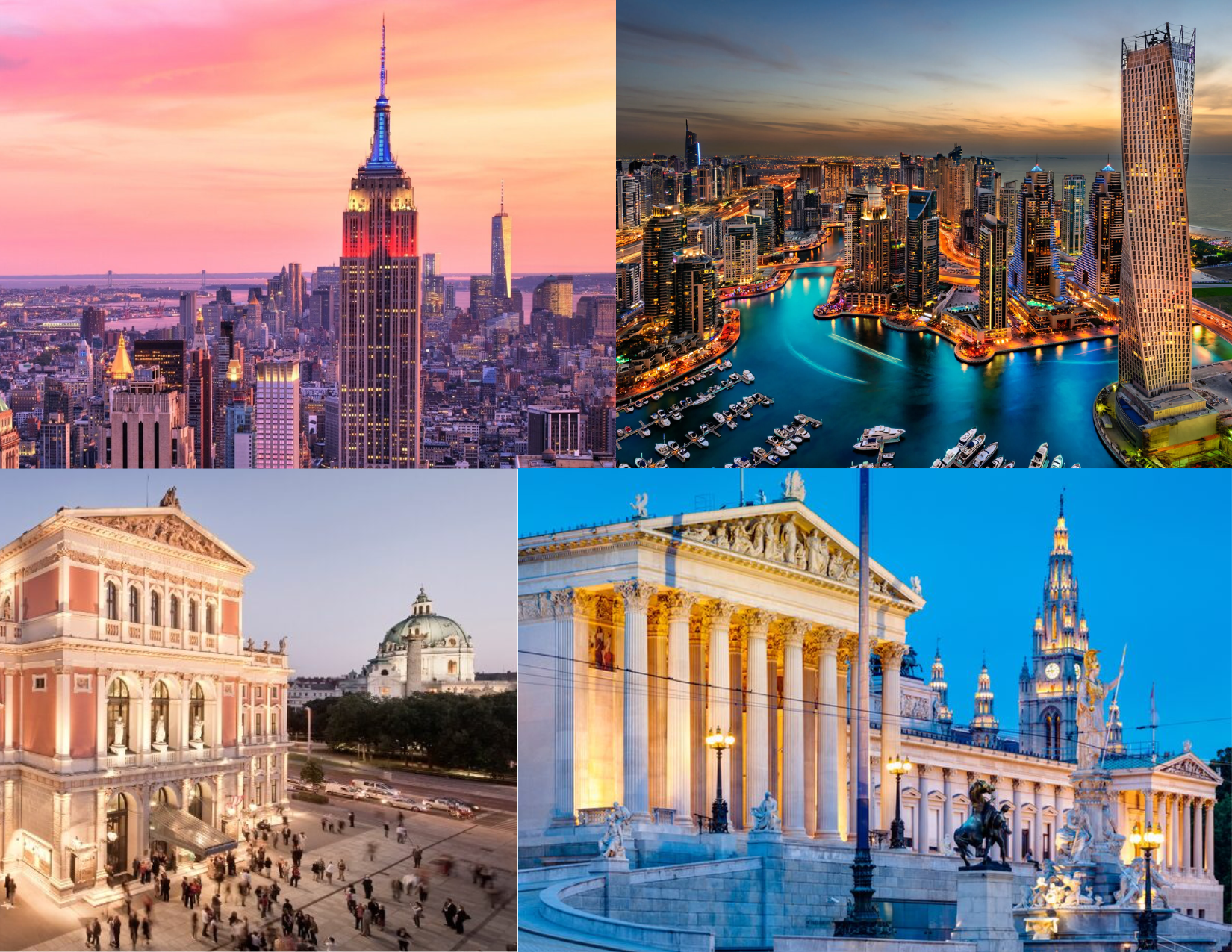
The Empire State, Dubai, the Wiener Musikverein
We also see it in literature. In 1984 Orwell goes to great lengths to ensure that the reader can’t help but feel the vastness and darkness of Oceania. He opens the book with a strange image of the clocks striking thirteen; he describes government buildings, massive 300-meter-tall white concrete pyramids that tower over the surrounding decay. Bradbury does something similar in Fahrenheit 451 when he describes massive billboards designed to catch the attention of drivers in cars speeding at a hundred miles per hour, and modernist houses without front porches and with TVs that cover every wall. Both in literature and in reality, architecture encapsulates in concrete and stone the values of a society.
The Greeks and Romans understood this concept, and they worked hard to perfect it. More importantly, they shared a common concept of beauty. They understood that the eye craves symmetry, that it yearns for uniformity and comfort, but not to an uncanny degree. Their architecture reflects this mature, but for whatever reason “outdated,” realization. When I first stepped before the Pantheon, armed with a camera in one hand and chocolate gelato in the other, I couldn’t help but feel as if I was in the presence of something infinitely sacred, something divine. When I entered, and when I looked up, I became overwhelmed by awe for the palpable brilliance engulfing me: the tile, the walls, the dome, the oculus, the sculptures, the art. Each precisely-cut stone was placed with intention. Each detail mattered and was given the attention it deserved. I knew instinctively that this was what science, what math, what intelligence, what philosophy, was for. Yes, this was the embodiment of genius.
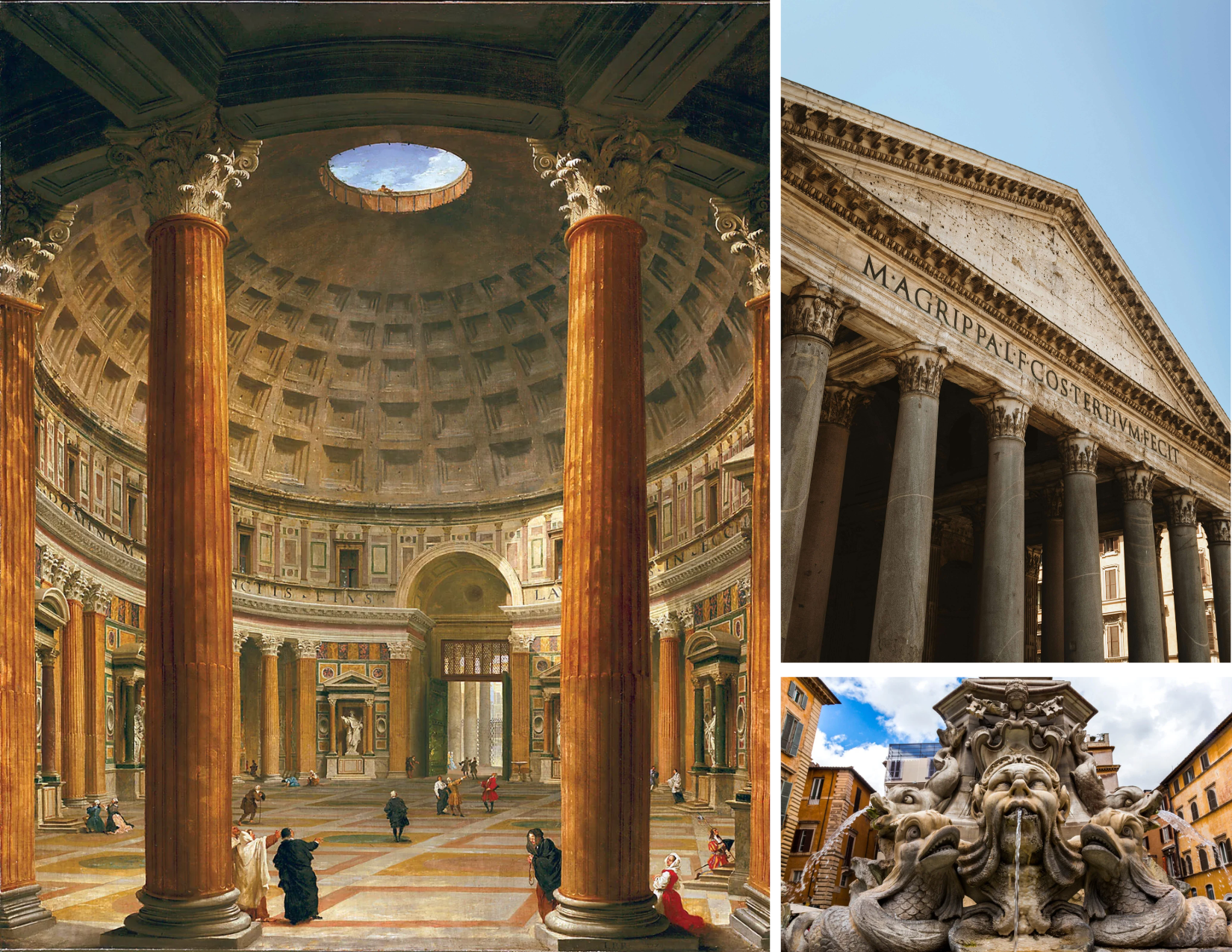
It should be noted that beauty is not synonymous with complexity. Some of the most beautiful things—a sunset, a tree, a column, a melody—are remarkably simple. Beauty is not intricacy more than an ability to draw us outside ourselves to something transcendent. It asks us to contemplate and feel nostalgia or shock, awe or childlike glee; that is, emotion. Beauty, in other words, asks us to wonder deeply and inhabit the world deliberately. Perhaps the tragedy of modern decadence is not necessarily because of a lack of complexity but because of a lack of honesty to one’s own instinct. Why has this happened?
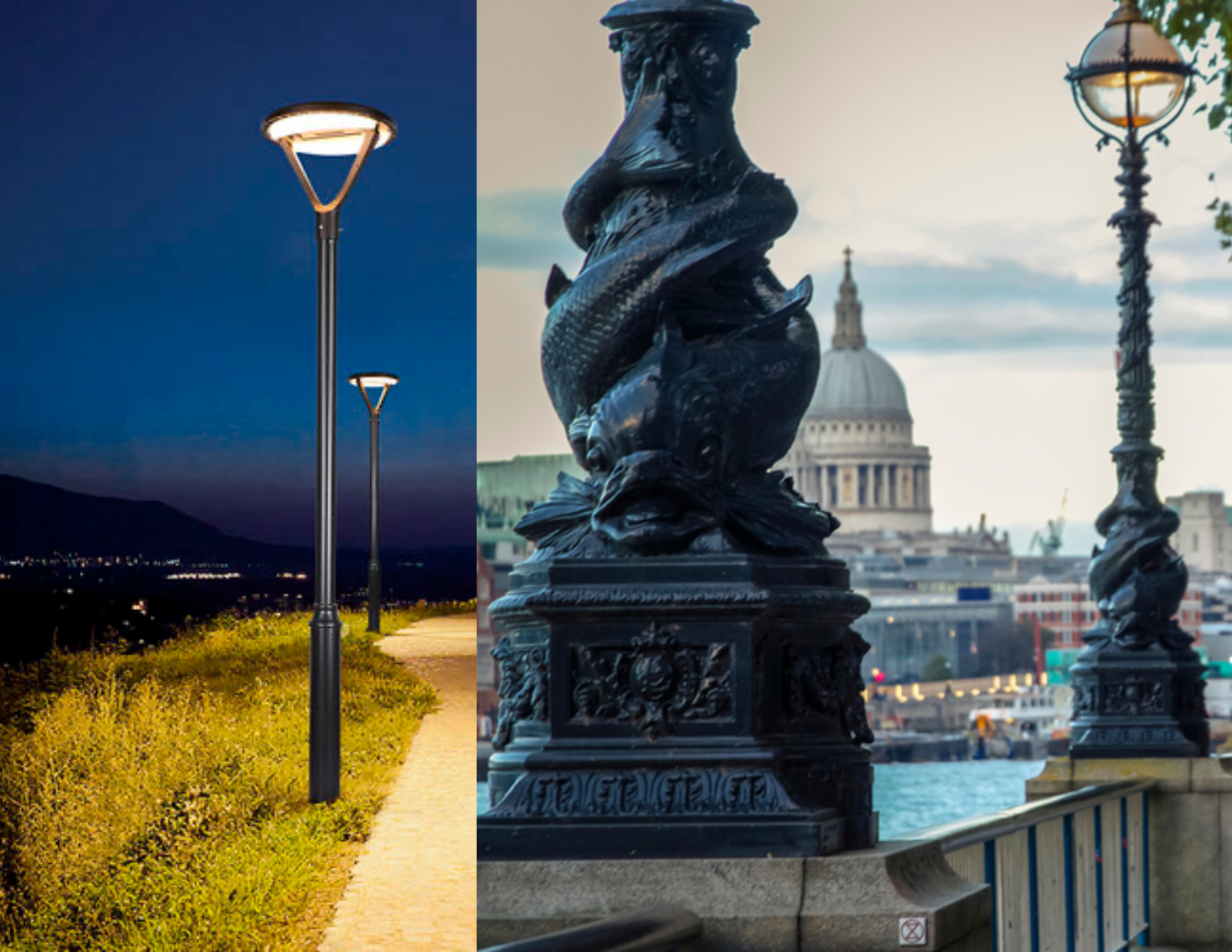
This is not about the merit of design (I find that the London lampposts can be quite strange); it is a mere observation of how even the effort to make public spaces beautiful has declined. It symbolizes a shift: that we no longer share the same idea of what beauty is; that “it’s not that deep”; that perhaps we don’t even know what beauty is at all; or that if we do, we don’t care enough to spend an extra penny on it. This observation can be more broadly applied: we have the potential, the capabilities to do breathtaking things more than ever before, but we choose not to.
3. Social Media and the Rise of the “Mass Man”
“To be surprised, to wonder, is to begin to understand. This is the sport, the luxury, special to the intellectual man. Everything in the world is strange and marvelous to well-open eyes.” — Ortega
“Society everywhere is in conspiracy against the manhood of everyone of its members.” — Emerson
As we discussed earlier, society has become increasingly unkind to complex beauty; that is, beauty that takes time and learning to understand, that moves beyond the primitive and into the refined. Indifference and ignorance are but symptoms of a disease: what Spanish essayist José Ortega y Gasset called “The Revolt of the Masses.”
In his view society is “always a dynamic unity of two component factors: minorities and masses.” The difference between the two is neither a matter of class nor salary. Nobility is therefore a status that is attained through choice not by birth. An aristocrat may very well be a mass man whilst a fast-food line cook belongs to the minority. The minority man is, then, Ortega puts quite tritely, one who in the pursuit of greatness—but not in a superficial sense, as in money; he means in service to an ideal, some transcendent duty—piles a great number of difficult tasks upon his back and strives for excellence, even if he cannot attain mastery; he believes that true vitality can be found only in effort, and makes a conscious effort differentiate himself. The desire to improve intellectually is the primary characteristic. Conversely, he says, the mass man is mediocre; but more importantly, he is perfectly content with his present condition, a “mere buoy floating on the waves.” So the qualities that differentiate the two—the masses and the minority—are determination to improve, and curiosity. To be clear, the minority is itself composed of people who have a binding similarity, just like the masses; but their shared characteristic is simply that they are different from the mass.
Ortega diagnoses the fall of creative pursuits as so: because the mass man is either too lazy or simply unable to understand the art traditionally associated with the minority—classical music, gourmet food, cinema—he declares them unjust and elitist and drags them down to his level, namely, to the level of mere entertainment. This is how we get trashy movies and sequels (cough cough Disney), lousy music, and incredibly unhealthy fast food.
The mass man attains his qualities for three reasons. The most interesting and compelling argument to me is his realization that the mass man is utterly disinterested in history. He sees no use in it and therefore exists in hermetic indifference to any life other than the one he is living. Ortega compares this to a spoiled child who accepts toys—our modern technology, our complicated legal systems and economies—but, in refusing to see the value of them, breaks them at the slightest vexation. In this way the mass man inherits the work done by intellectuals and academics who dedicated their lives to some greater human destiny, but, instead of revering the world he inherited, attacks it, demands instant solutions, and resorts to direct action—boycotts, violence, riots, cancellation—to get his way. He will attempt to burn down the very systems that have kept him and his lowly intellect afloat. In the process he loses sight of some greater ideal, some final human destination which his ancestors could see clearly, and instead metamorphosizes from an inheritor to a parasite; he revolts against his own destiny. Shortly after the Spaniard published this book in 1929, his chilling theses would soon be proven almost in its entirety in Spain and indeed around the world.
To speak truly, there is an element of elitism in Ortega’s arguments, and some of his implicit solutions—i.e. we must eat gourmet, artistic food over fast food—are luxuries only applicable to those in the upper bourgeoisie and above. There are real barriers in some places preventing and discouraging people from appreciating high culture. But there is also quite a bit of merit in his arguments, especially when applied to the bourgeoisie, which has no such excuse. In this regard there is, I think, more just one type of mass man: he is someone who, though curious (he cannot help it, for curiosity is in his nature), suppresses his curiosity and his intent on being learned, in order to willingly conform to mass culture because it brings him community, identity, and popularity. Perhaps I am blinded by a romantic worldview informed by reading unholy amounts of Emerson instead of Marx, but in my view the mass man is not so much a destructive force when treated as an individual who simply needs to be excited. Thus the blame shifts from on the individual to on the institutions and the bourgeoisie considered as a mass.
That said, when one thinks of screaming social activists who don’t listen to reason, there are also those who, as Ortega cynically and truthfully suggests, really do believe themselves to be correct about everything; they lack the humility required for curiosity, they have “ideas” but they are simply prejudices disguised as opinions, they conform because he physically cannot conceive of thinking differently, they believe everything they see or hear online. When such a mass gains power, as they have in the United States thanks to the equal vote and liberal democracy, they vote for the politician who promises immediate fixes, which, as history shows, are rarely fulfilled at best and, at worst, eventually liberate society from liberalism and result in authoritarianism. This is the path which America seems to be taking. Why is nothing being done about it?
I am going to college and I feel as if I have barely learned anything at all. I do not feel prepared to make a difference in the world. I fear Emerson’s dire warning—that “a foolish consistency is the hobgoblin of little minds”—has realized itself upon me. Originality eludes me; I chase it and grab for it in vain. In its dearth I fail to infuse my life with meaning, for without originality, one, with time, fades away into nothingness.
Many public high schools are designed by prison architects, and those that aren’t, like my school, may as well have been. Students walk through gorgeously bland hallways lit by harsh industrial lighting. If architect Louis Sullivan’s famous “form follows function” holds true, what does that say about the state of modern education?
4. Our Failed Public Education System
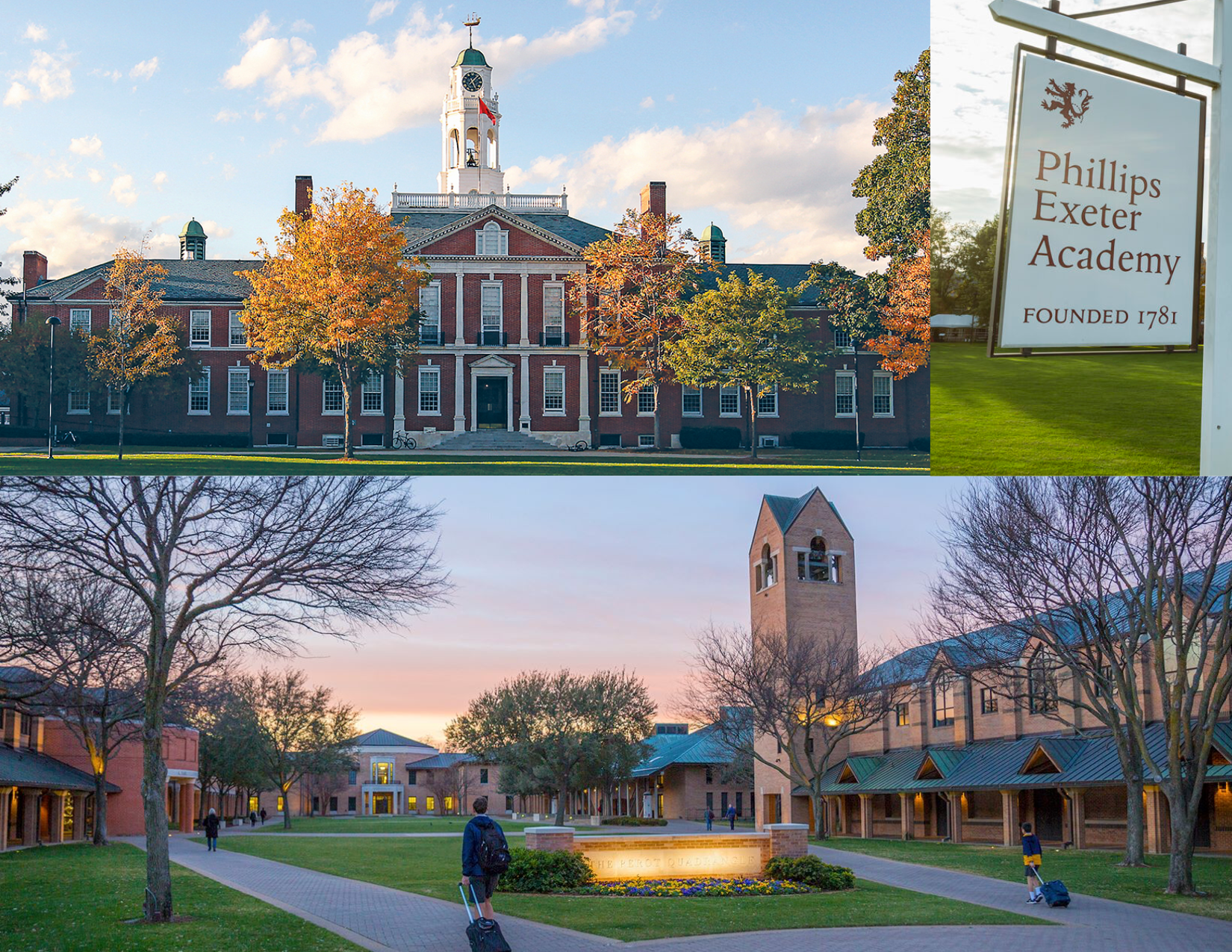

Left Top: Phillips Exeter Academy; Left Bottom: St. Mark’s School in Dallas; Right: Public schools (in wealthy areas, it should be noted. Even with wealth the schools are designed brutally.
There is no beauty in the building that is supposed to instill objective good—wisdom, beauty, curiosity—into the soul. In fact, infused into every brick and steel beam is the absolute antithesis of those objective goods: the belief that the function of educational institutions is not one of learning or creativity, but of submission and a salary.
Education is no longer a means to becoming a better, more enlightened, ethical human being. The “genuine love of learning” part of school has become a bygone, an annoying obstacle in the way of securing a prestigious job. To understand why big public high schools are the way they are, it would serve us well to look at what they prepare the students for: elite institutions. Public schools know full well that affluent parents, wanting to improve Little Timmy’s chances of going to Yale, will choose their school only if they can offer the most advanced classes, boast high average SAT scores, and exhibit a history of sending kids to such institutions.
Our core curriculum is a prime example of this priority. It’s painful to even call it a core curriculum because it covers everything but what’s core—philosophy—and fails to cultivate the most important human qualities that are already in short supply: skepticism and curiosity. It begs the question: What does our school system consider “core” to the education of young men and women? Evidently not true learning, but rather pattern recognition and standardized test-taking. This, in turn, begs an even more fundamental question: What is the point of high school, of education in general? Is it to destroy creative children and transmute them into obedient workers that exclusively work in STEM and finance? Or is it to produce critically-thinking, ethical human beings who change the world through a wide variety of fields? Our curriculum, inundated with AP math, science, and poorly designed humanities classes, suggests the former. And, if students take anything other than AP courses, they are “punished” for it. By taking an unweighted elective that may fascinate the student more, the student hurts his GPA; and in a system where each hundredth of a decimal determines one's rank, each point can mean the difference between being rank 20 and rank 40. In states like Texas, that could be the difference between gaining admission to state schools or not. Consequently, students take courses they couldn’t care less about to boost their GPAs, resulting in disengaged classes filled with sleeping students. Is this really the way things must be?
Notwithstanding the egregious sin of sacrificing curiosity and creativity for standardized tests, the education system has failed us even more by failing to help us take control of our worldview through rigorous self-education and reading, instead allowing social media to cultivate our worldview for us. Throughout history, much learning was done through reading and discussing ideas. In Ancient Athens students memorized immense amounts of Homer. In Ancient Rome they read Virgil and Cicero. In Han China they had to know entire books by heart. While this writer finds rote memorization of entire texts ridiculous, there was a good reason why the ancients so valued the written word: reading history and literature and philosophy cultivates a thoughtful, thorough worldview. Now that we don’t read—much less discuss ideas—anymore, we no longer understand why learning is important at all. I know of many people who don’t care about history, literature, and philosophy, and who sleep in class right in front of the teacher! This is evidence of the gross failure of school: “literature teaches you to think differently and gain a different perspective,” they say. How banal and hackneyed of an inanity is that! Instead, why don’t zealous teachers teach us why we should care about calculus, the Renaissance, or the Stoics? Is history nothing “but the biography of great men,” as Carlyle put it? Or should it be retold, as Zinn believed, from the bottom up? Or regarding literature: why should we care about Hamlet, a play written in what can seem like a foreign language? Perhaps even more fundamentally: why should we care about education, and what is the good life we should strive to achieve? These questions, which help students understand why they should love learning and living, are by no means self-explanatory.
But teachers are not trained to help us answer these essential questions—they are instead shackled to the disgustingly superficial standardized curriculum, which itself takes away from the student’s ability to read extensively in his free time. Perhaps if we read Herodotus we would better appreciate the, sometimes funny, study of the past (he claims Arion, a wealthy musician, was thrown off a ship by pirates but was saved by riding a dolphin to Corinth); if we read Shirer’s The Rise and Fall of the Third Reich we could better sympathize with the victims of the Holocaust; if we indulged in the Odyssey we could better visualize determination and masculinity, arrogance and cunning. But we don’t. Instead, when not doing the same type of math or physics problem thirty times, we waste away on social media, which reaffirms our idea that the answer to everything is money and that our problems are not really our faults but someone else’s. That our school system prevents us from exploring these great works, thereby precluding an education by learning subjects from first principles so as to better understand them and build upon them, and instead thrusts upon us useless busywork in preparation for regurgitation is bewildering, depressing and outrageous.
Top university admissions are also a problem, albeit a much smaller one than public schools. As David Brooks writes in his feature article for The Atlantic, elite institutions should input unremarkable kids and output remarkable ones, but in reality that is far from happening. Why, then, should we celebrate that these universities boast about turning away huge numbers of qualified students? Exacerbating the issue is the vague—and seemingly unfair— admissions process, as Yale’s own faculty points out. Students from families with an annual income of $611,000 or more that check a box on the application that reads “No. I’m not applying for financial aid,” are twice as likely to be admitted to the Ivy League when compared to low- or middle-income families with comparable standardized test scores. Even more consternating, they are 77 times more likely to be admitted than those who come from families that are low income. The admissions process may be a meritocracy in that it finds the most accomplished applicants, but it seems to be unable to properly account for the fact that not everyone has even close to the same opportunities as each other. A stupefying 30% of students at Phillips Exeter, for instance—who pay $56,000 annually in tuition, and who enjoy passionate teachers and a wide selection of fascinating courses—matriculate to Ivy Leagues and peer schools. And though they pay the same amount for a year of school that the average American makes in a year, they deserve admission, because unlike the majority of American children they receive almost the equivalent of a college education in high school. As James Marriott writes in the Times, “elite colleges were supposed to prevent the creation of an American aristocracy; instead, they’re building one.”
The current public school system, with its ridiculous AP “curriculum” and decimal ranking system, must be thoroughly reformed and replaced with something that features unrestricted intellectual exploration, reading, discussion, and passionate, well-educated teachers.
5. The Solution: Humanism
After writing essays on the internet for three years now and helping grow Philosophy Club from nothing to 40 members, I can proudly say that, in my experience, oftentimes just beneath a mass man is a very interesting person; he or she just needed a little time to shed the unnatural exoskeleton chaining them to the multitudes. What I’m trying to say is, philosophy and art fascinates people in ways they never knew, and it changes them. Some come to the club for the first time nervous and unsure of what to expect but leave laughing and excited. Sometimes they even research ideas for the next meeting. There’s community to be found in the mass culture movement, sure, and it takes relatively no effort to join; but there’s also community here—where, with a little more effort, the best of humanity is brought out to shine: rigorous curiosity, deep thoughts, funny thoughts. Philosophy Club proves that thinking, growing, and speaking with others is exciting. In a practical sense, it also shows that there’s real demand for spaces where one can escape the multitudes. It conveys the thirst for humanism in my generation, and perhaps in the country more broadly, as the antidote to conformity and cynicism.
Marcus Tullius Cicero was the first to describe the liberal education with the Latin word humanitas. Its etymological derivative, humanism, came to define a philosophy, a worldview, defined by a lifelong dedication to virtue, civic life, and wisdom. It is—through a diligent investigation of the classics, philosophy, theology, literature, history, poetry, music, and art—the quest for understanding where one comes from and how one can best live a good life. Renaissance humanism, which popularized humanism, was, at its core, a reform of culture. Europe had spent far too long bundled in the shadowy cocoon of the Middle Ages; it was time for the continent to escape, to grow wings of idealism, to soar upwards and realize humanity’s sublimest potential. This may seem like a lot of purple philosophical prose, but in reality education forms culture, and culture really does precede all else. Brooks, in his NYT Farewell, references Burke, who writes, culture is “of more importance than laws. Upon [it], in a great measure, the laws depend…manners are what vex or soothe, corrupt or purify, exalt or debase, barbarize or refine us.” If culture changes, politics, economics, and everyday life will too.
We shouldn’t aim to emulate the past in its entirety, of course; but it would do us well to cautiously borrow the positive elements of a culture that produced so many prodigies, so much talent, so much beauty. Settling for mediocrity, like the generation above us did with the public school system, is a choice. The easy way out is to let things be, let them rot and decay. The other option is to educate ourselves by joining the Great Conversation, the millenia-old ongoing dialogue, from Socrates to Herodotus, Sophocles to Nietzsche, Friedman to Emerson, asking the big questions on those timeless topics: Does God exist? How should we define justice and beauty? Do we have free will? What makes a war just? These are some of the fundamental “why” and “what” and “how” questions that implore us to think deeply for long periods of time, that make me feel stupid and ignorant.
One of those important questions—one that, if you’ve read the article closely, you will realize I breezed over earlier—asks, what is beauty?
There is, I believe, a part of the human essence, some chemical cocktail, that lights up with excitement when we are in the presence of genius, of originality, of some great undertaking. It’s possible to dim this part but not to fully extinguish it, for if you did, you would no longer have the flame, the curiosity, the attraction to genius, to be human. This quality is what sets us apart from animals. Beauty, I think, is anything that instills in us a sort of fuzzy childlike delight. It is at once an intuitive appreciation for complexity and a sudden realization that we are in the presence of something transcendent and non-human. Beautiful art pulls a person out of the cynical abyss he inhabits and brings him to the precipice of wonder, from which he can look around at how the world really looks.
Classical music, for instance, demands more from the listener than just his ears. Take Bruckner’s 7th symphony. It challenges the listener to have compassion, understanding, and appreciation. It doesn't smash the artwork’s meaning over your head like contemporary music does; it tells a story, complete with ups and downs, climaxes and resolutions. It has structure, but is not repetitive. Most importantly it takes time and quiet to enjoy. It bids the listener to use his brain and contemplate what the music is telling him. Where a pop song blasts a constant beat and a repeated, transposed melody, Bruckner employs counterpoint and dynamic and harmony and voice, while Karajan, the maestro, interprets the artwork, thus lending an even richer experience than just a technically correct rendition. While current pop music is simple and flat and, at times, vulgar, classical music is complex and contoured and refined.
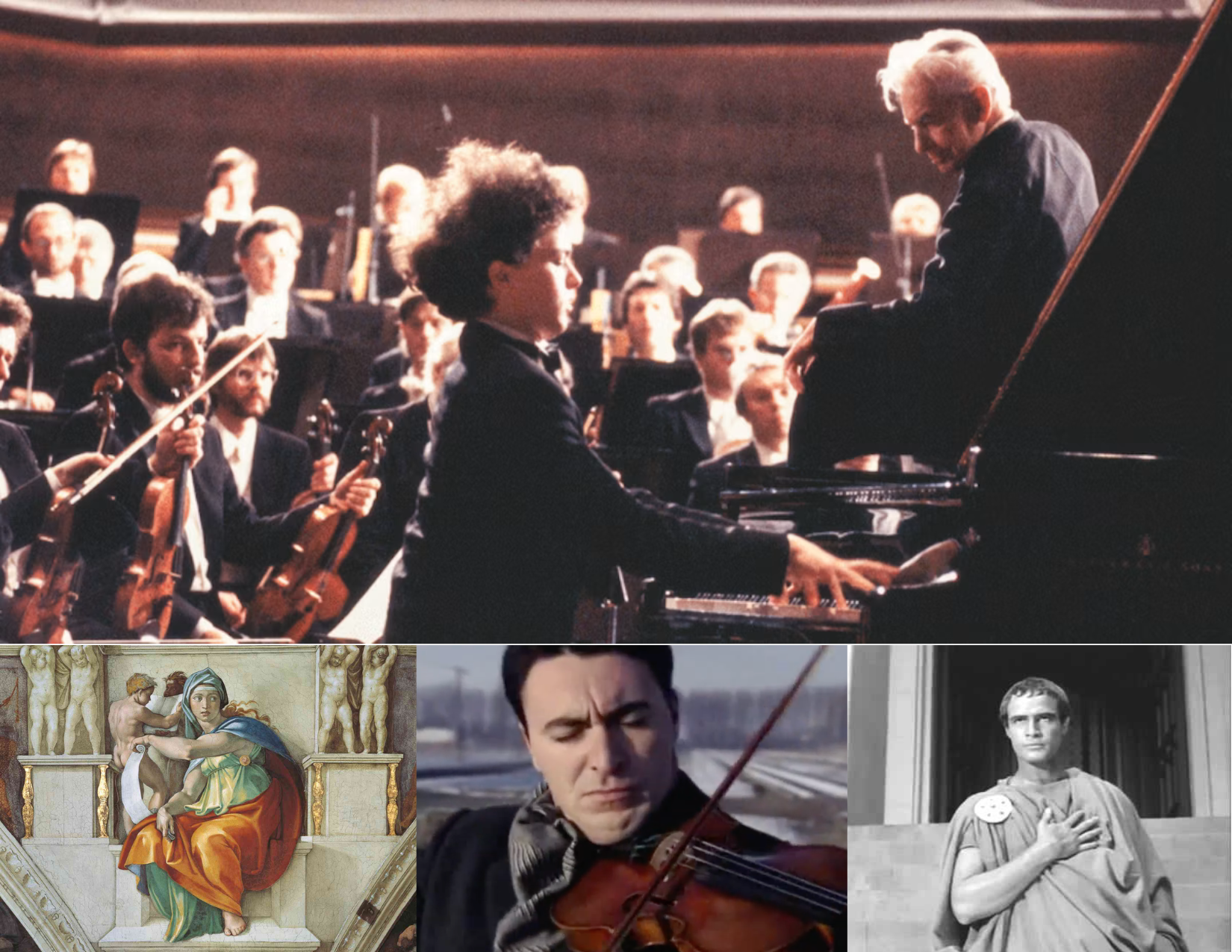
Top: Kissin plays Tchaikovsky’s Piano Concerto No. 1 with Karajan at the stick. Bottom, left to right: Michelangelo’s Oracle at Delphi; Vengerov plays Bach’s Chaconne in Auschwitz’s ruins; Friends, Romans, Countrymen
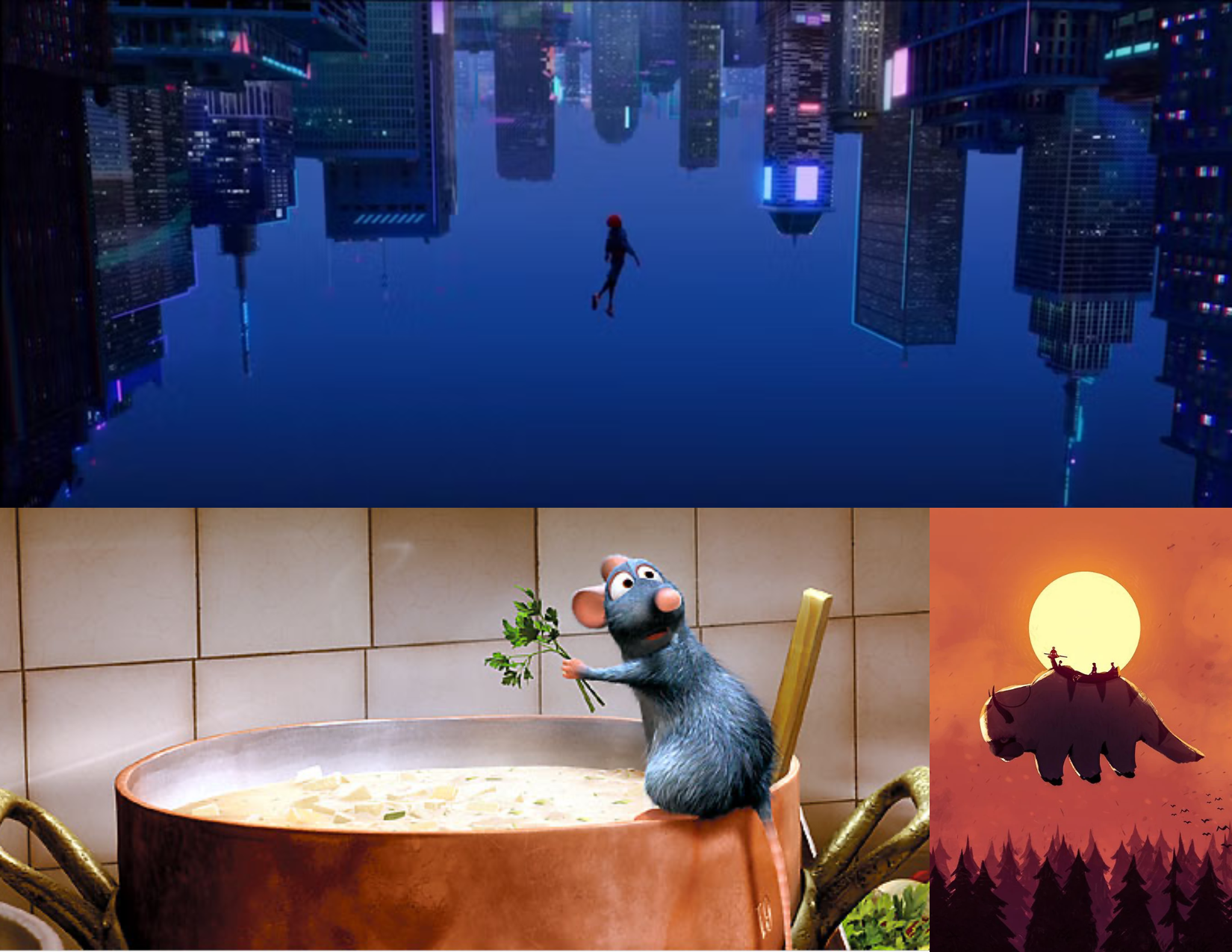
By humanism I don’t just mean discussing dead white guys, going to a classical concert, or analyzing the Oath of the Horatii. Remy proving to Ego that “not everyone can be a great artist, but a great artist can come from anywhere, is humanism. Aang fighting in an epic battle against the Firelord’s fascism and totalitarianism, is humanism. Miles Morales taking a leap of faith by jumping off a skyscraper without fully knowing whether he can swing, is humanism. Anything that celebrates the pursuit of realizing human potential is humanism. You shouldn’t be joining just one conversation. The point of the Great Conversation, of this article, is not to urge you to become a philosopher or a writer or an artist, or to spend every waking second reading a great book; it is simply an attempt at teaching one how best to be human. And while it would do one well to indulge in classical music and art, there’s also a time and place for mass culture, where it makes sense and where it can be fun—every once in a while. In my view thinking and reading and discussing should be accessories, ways of helping one live thoughtfully and deliberately, in addition to other intellectual and personal pursuits. Indulging in the New York Times during your morning bathroom trip, reading 20 pages a day of an interesting novel, discussing theology with friends during a car ride instead of blasting awful music—these are examples of what I think living deliberately may look like for modern man. Appreciating culture traditionally associated with the minority is not mutually exclusive with your life—unless you listen to Cardi B and are an ardent democratic socialist and the like, in which case I hope my essay has convinced you to at least try substituting Cardi B for Mr. B (Bach).
Unfortunately, I am now seeing some of the dangerous preconditions that I read about in Shirer’s history of Nazi Germany beginning to brew: cynicism, antisemitism, socialism, violence, partisanship—and not enough balanced skepticism. To be sure, progress is almost always a result of skepticism; for within every skeptic is the belief that things could always be better, be more efficient, be more humane, be more just, be more right. Suspicion of governments, people, and ideologies are often justified, but in this age, owing to the news and to social media, the whole picture is often hard to come by, and people make decisions on issues they aren’t entirely familiar with. Skepticism must be equitable; otherwise it becomes prejudice.
Humanism asks something much simpler than modern life does. It does not ask how quickly we can produce, consume, or automate. It asks whether, standing before the Pantheon, listening to a Bach partita, or reading unreadable Hamlet, we are capable of wonder. If we can still wonder, then civilization is not lost. There remains something within us that no algorithm can automate and no ideology can extinguish. Whatever that small flame may be—our curiosity, our love of beauty, our desire for truth—is what makes us human. Our task is simply to keep it alive.
As we discussed in the introduction, our generation harbors some of the greatest problems man has ever had to face. Granted, that is what each generation believes, but the existential threats—environmental collapse, artificial general intelligence, microplastics, nuclear war, a changing world order in which the West is neither the most powerful nor the most feared—and the personal battles—against social media addiction, a terrible education system, mental health problems—we must fight are staggering. But we must not become cynical or nihilistic; we must hold out. If we further analyze the things written about in these articles—I’m certainly not profoundly correct about everything I’ve spoken about, but it’s a start—then I think we have a chance at addressing the great problems that we are struggling against. The conversation must at least begin. And I have invited you to join.
Aut viam inveniam aut faciam